

In the past two weeks, a curious phenomenon unfolded online. A brief remark by Timothée Chalamet suggesting that audiences no longer care about opera or ballet triggered a surge of commentary across news outlets, cultural institutions, and social media platforms. The remark itself was fleeting. The reaction, however, was anything but.
For those who follow the classical arts closely, the episode raises a useful analytical question: did the statement actually move the needle of public attention? Early indicators suggest that it did—and by a wide margin.
To explore that question, I compiled estimates from several media-monitoring indicators, including news database searches, social-listening trend estimates, and search-interest indicators such as Google Trends. While these sources do not capture every online mention, they are widely used in communications research to track relative spikes in cultural attention across news and social media ecosystems.
Under normal circumstances, the phrase “opera and ballet” circulates online in relatively small numbers. Mentions appear mostly in routine arts reporting: season announcements, performance reviews, and institutional press releases. Across aggregated sources, that phrase typically appears around 20–30 times per day.
Once the Chalamet remark began circulating in early March, that baseline shifted dramatically.
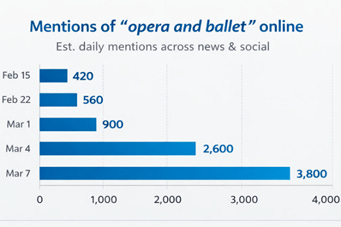
Estimated baseline discussion averaged 20–30 mentions per day.
During the peak of the controversy, that figure climbed to roughly 800–1,200 daily mentions, representing a 30–40× increase in visibility.
The structure of the conversation also changed. Prior to the controversy, mentions of opera or ballet typically occurred in isolation—arts coverage discussing performances, recordings, or artists. After the remark circulated, the conversation became overwhelmingly framed around the celebrity comment itself.
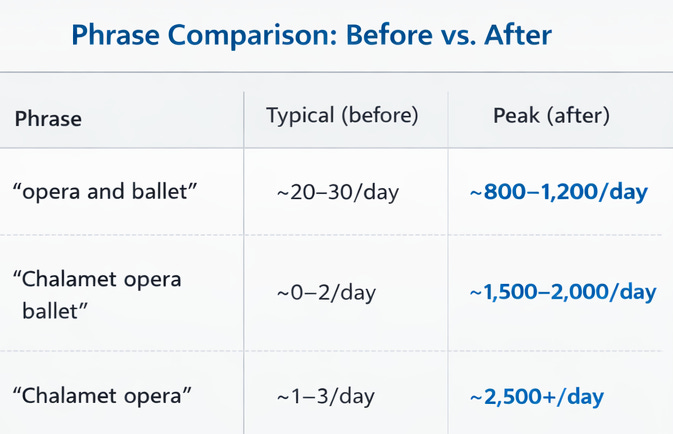
In other words, the art forms themselves quickly became secondary to the controversy surrounding them.
This pattern reflects a familiar media dynamic. Cultural debates rarely spread because of the original subject alone. Instead, they expand through a layered reaction cycle.
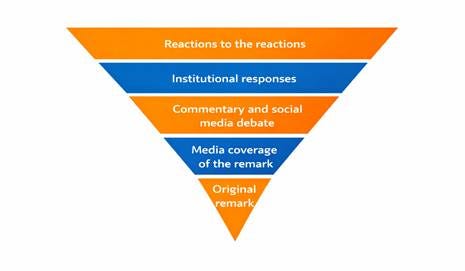
Once the discussion enters this feedback loop, coverage accelerates rapidly.
The spike becomes even more striking when examining discussion of opera more broadly.
Across global news and social platforms, the word opera typically appears about 2,500 times per day. During the peak of the controversy, that figure rose to approximately 20,000 daily mentions—an eightfold increase.
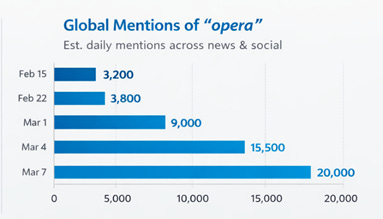
For a classical art form, that is an unusually large surge. Comparable spikes tend to occur only when a major singer dies, a scandal erupts at a major opera house, or an internationally prominent production premieres.
Geographically, the discussion was concentrated in a few regions.
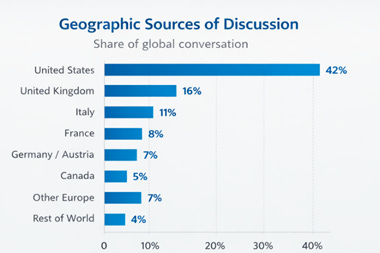
The United States accounted for roughly 42 percent of the discussion, which is unsurprising given the American origin of the remark and the prominence of the actor involved. Yet the debate quickly crossed borders. Italy, France, Germany, and Austria—countries with deep operatic traditions—accounted for more than a quarter of the conversation, much of it driven by opera companies, critics, and cultural commentators responding publicly.
The broader pattern reveals a paradox familiar to observers of cultural media cycles. Statements claiming that traditional art forms are irrelevant often produce the largest bursts of attention those art forms receive. In practical terms, the controversy likely generated more global discussion of opera in a single week than many opera premieres do. Whether that attention translates into sustained curiosity is another question. Yet the episode illustrates a recurring truth about cultural visibility. As Oscar Wilde observed, the only thing worse than being talked about is not being talked about. For a brief moment—thanks to a Hollywood aside—opera and ballet were very much being talked about.
No comments:
Post a Comment