Showing posts with label Omaha Symphony. Show all posts

Sunday, October 28, 2018

All Russian, and it was good,,,,


It was all Russian last night at the Omaha Symphony (OS) with guest conductor  Bulgarian-born Stilian Kirov.  He is currently music director of the Illinois Philharmonic and is a graduate of the Juilliard School, and he has held associate conductor positions at the Seattle Symphony and Memphis Symphony.  Maestro Kirov addressed the audience while the piano was moved center stage for the Tchaikovsky; he has a charming manner, composed of a bit of awkwardness and intellect.  His conducting manner, however, is understated and controlled.

The program began with Shostakovich's 1954- Festival Overture.  It is much less portentous than his other works that seemed mostly designed to be a comment on Communist rule, and especially Stalin.  It could be considered a glimpse of what might have been had the composer lived where it was not necessary to continually make political comment through his music.  It begin with a brass fanfare that was played beautifully here, except for a light raggedness at the very beginning.  But overall, it was well-played and a great way to open a concert. 

The Tchaikovsky Piano Concerto followed, with soloist Tanya Gabrielian.  This way overplayed concerto is difficult to play in a manner that wrings out new meaning.  And Ms. Gabrielian's performance was no exception.  She and Kirov seemed to share a musical vision of the work, and the OS played a very sympathetic accompaniment.  The first movement was grand with its well-known introduction that has little to do with the remainder of the work.  The second movement Andantino semplice, was played with as slow a tempo as one could imagine, and seemed almost to go somnambulant in the last third of the movement.  The final movement was suitably colorful with just the right amount of bombast.  But Ms. Gabrielian, who seems to have great technical proficiency, had some usual phrasing that at times interrupted the music's flow.  It was as if she was trying not to make a mistake, and in doing so, misshaped the musical line a bit.

The final work was the majestic Prokofiev Symphony No. 5, a masterpiece of 20th century music.  Maestro Killian and the OS gave an inspired performance.  Some of the highlights included a hair-raising finale to the First Movement, Andante.  The second movement, Allegro Moderato, was playful with a brisk tempo.  The third movement, Adagio, was suitably dark and mysterious.  The fourth movement Allegro gracioso, which revisits the main themes of the previous movements, was thrilling, and again built to a powerful climax. 

The OS consists of 42 employed musicians, with others added as needed.  But nevertheless, the orchestra plays with cohesion and musicality.  The brass are very, very good, and the French horns would make a larger orchestra proud.  The cellos are precise orchestral balances seemed quite  good.  The acoustics of the Kiewit Auditorium at the Holland Center are magnificent, affording a nice wide, but integrated stage.  Maestro Kirov was impressive, and likely has a great future.  It was a very satisfying concert.

Sunday, April 15, 2018

Cold Weather, Warm Concert...


April weather in Nebraska is unpredictable, the onset of a winter storm with blowing snow is never welcome.  But the Omaha Symphony, under Music Director Thomas Wilkins, providing some welcome musical heat.  The OS has the Holland Performing Arts Center as its home; it is a facility with extraordinary acoustics. The sound of the orchestra is warm and never muddied; for example, percussive sounds  are never smeared and every strike of the tympani can be heard, without sacrificing fully focused and integrated sound.  The strings are wrapped in wonderful reverberation that creates a golden timbre.  The sound wall can sometimes seem a bit distant, but the volume of the full orchestra is never ear-splitting.  The Holland provides the audience with a gift of fine sound.

The first work was Bernstein's "Slava: A Political Overture," which was composed to celebrate the arrival of Mstislav Rostropovich as the Music director of the  National Symphony in Washington, DC in 1977.  It is a light-weight piece that seems mostly like rehash of Bernstein's Overture to "Candide." It is brassy, percussive, rhythmic, and cheerful.  The composer added in some audio effects, mostly excerpts from hackneyed political speeches.  At the conclusion of the work, the orchestra members shout Slava!  This gimmicky work is a good way to start a concert and it won't be troublesome if I have to wait till the next centenary of Bernstein's birth to hear it again.

Bernstein's "Serenade, after Plato's Symposium" followed on the program. This is the third performance I have heard of this work in the past two months.  The first was in mid-February at Lincoln's Lied Center, performed by the Saint Louis Symphony with violin soloist  
Kobi Malkin and the second was about a week ago with Robert McDuffie, violin, and the Atlanta Symphony Orchestra. The soloist in the present performance was Liza Ferschtman, who gave a strong performance, but without the searing intensity or absolute technical mastery of either Malkin or McDuffie.  The overall performance was fine, but it lacked the intensity and tension of either the Saint Louis or Atlanta efforts. Without doubt, the acoustics of the Holland added greatly to experience. Acoustically, the Lied Center was a close runner-up, with Atlanta's Symphony Hall trailing considerably. 

The final work was  Mahler's  Fourth Symphony.  It is a resplendent work, with wonderful lyricism and great beauty. Maestro Wilkins obtained some fine playing from the OS in the first movement,  from the sleigh bells to the  clarion flute melody in the middle of the movement.  The second movement, however, lacked integration and seem to move forward in a series of fits and starts.  This was likely due to some  ragged entrances by various sections of the orchestra.  The third movement, with its gorgeous introduction, was lyrical and warm and the music progressed in a nicely controlled fashion, as it lead to a grand climax that reiterates the flute solo from the first movement, played by the brass.  This movement was a opportunity to hear some fine playing from the OS cellos, violas and double bass.  The final movement introduces a soprano, here Amy Owens, who sings Das kimmlishe Leben.  Ms Owens's nice voice  struggled to be heard over the orchestra at the start of the movement, but as the music progressed, her voice grew stronger and more accessible. In all, this was a beautiful, golden-sounding conclusion to this monumental work.

At some points in the Mahler, the violins had some absolutely remarkable ensemble.  The brass were quite strong throughout, with some great playing by the horns, save for a few intonation issues.  The English horn played with a rich gentleness.  The violin solos, played by Concertmaster Susanna Perry Gilmore and Associate Concertmaster  Ann Beebe, were both musically and technically brilliant.


Friday, February 3, 2012

Pleasantries...


On February 2, 2.012, the Atlanta Symphony, under guest conductor Thomas Wilkins, presented a program that included: 
Ravel:  Mother Goose Suite
Beethoven:  Con.certo No. 3 in C minor for Piano and orchestra, Opus 37
Dvorak: Symphony No. 8 in G major, Opus 88
The piano soloist in the Beethoven was Gabriela Montero.

Maestro Wilkins is the Music Director of the Omaha Symphony and the Principal Guest Conductor of the Hollywood Bowl. Last June I had the pleasure of hearing Wilkins and the Omaha Symphony Play in their magnificent home- the Holland Performing Arts Center.  The program included Vaughn Williams’ “Fantasia on a Theme of Thomas Tallis” andMahler’s Seventh Symphony. The Tallis Fantasia was wonderful.  The acoustics at the Holland warm and reverberant, yet the string quartet could be heard separately from the entire string orchestra, and placed exactly in the acoustic space, even from the balcony, where I sat.  Vaughn Williams favored the darker strings, i.e., the celli and violas, in this work and the Holland treated them with respect.  The Mahler benefited similarly.  In my review at the time, I made a few comments about Maestro Wilkins and they remain true, given last evening’s performance.  I have included my earlier comments along with photos of the Holland for reference. 

The ASO concert began with the “Mother Goose Suite.”  This is gentle music perfectly suited to youngsters- it is gentle and lacks bombast.  The orchestra is pared down considerably, with the only brass being two French horns. The only principal playing from the full ASO that I could identify was violist Reid Harris.  There is something so atmospheric about this music that it is almost otherworldly.  It also may not be the best piece to begin a concert program.  The audience had not yet settled down and rid themselves of their coughing, so the background noise was at odds with the music’s delicacy.  Nevertheless, it is a wonderful piece.  The ASO musicians performed admirably, especially Associate Concertmaster William Pugh.

In the Beethoven, pianist Montero and Conductor Wilkins seemed to work together well.  The ASO was disciplined, and Wilkins paid great attention to Montero.  The Largo highlighted the skills of the ASO’s string section; they played cohesively and with silky smoothness.  Montero takes advantage of the full capabilities of her instrument.  From the tiniest pianissimo to the grand fortes she is in command.  Her left hand seemed particularly strong, but never overbearing.  The ASO audience, as it does every week, gave the performers a standing ovation.   Maestro Wilkins was quick to give recognition to the orchestra’s individual players before accepting the audience’s thanks on his own behalf.  After all the hubbub settled, Ms. Montero, who is known for her improvisational skills, requested that someone in the audience hum a tune that she could use as the basis for showcasing her prowess.  Well, no one took up the challenge to hum, and someone suggested she play “MacArthur Park.”  She seemed perplexed by the request, as did Wilkins.  I assume an old hippie made the request.  Anyway, someone finally shouted “Summertime,” which seemed to be more to Montero’s liking.  What followed was about 8 minutes of wonderful music making that included improvisations in the style of Rachmaninoff, Bach, and Rifkin.  There may have been others in the mix, but suffice it to say that at the end, the audience again went rapturous. 

The final work was the Dvorak.  I have heard this work so many times throughout my listening career that it sometimes loses my interest.  In fact, the ASO programmed it just two years with Mei-Ann Chen as conductor.  Wilkins provided a much more disciplined piece.  His conducting style makes no doubt about the beat, with is right hand acting as a batoned-metronome.  His left is giving cues to the orchestra about entrances and dynamics.  The ASO again performed skillfully.  The woodwinds, including Christina Smith on flute and Laura Ardan on clarinet, were in top form.  The brass were also standouts.  This was a sunny performance that almost revived this warhorse for me. 

As noted, Wilkins is firm in his beat.  I was surprised at how much he had to refer to the score in each piece.  At some point when he commits more to memory, he might attend even more to nuance.  This did not seem to impair his performance with the ASO, but I found it distracting when he occasionally flipped pages back and forth. He also seemed to use his baton as a bookmark at one point.  Mr. Wilkins is a tall and  elegant conductor who looked great in a well-tailored tux

. 
This was a very pleasant and well crafted concert.  It certainly was an opportunity to spotlight Ms. Montero’s skills and Maestro Wilkins’ orchestral control


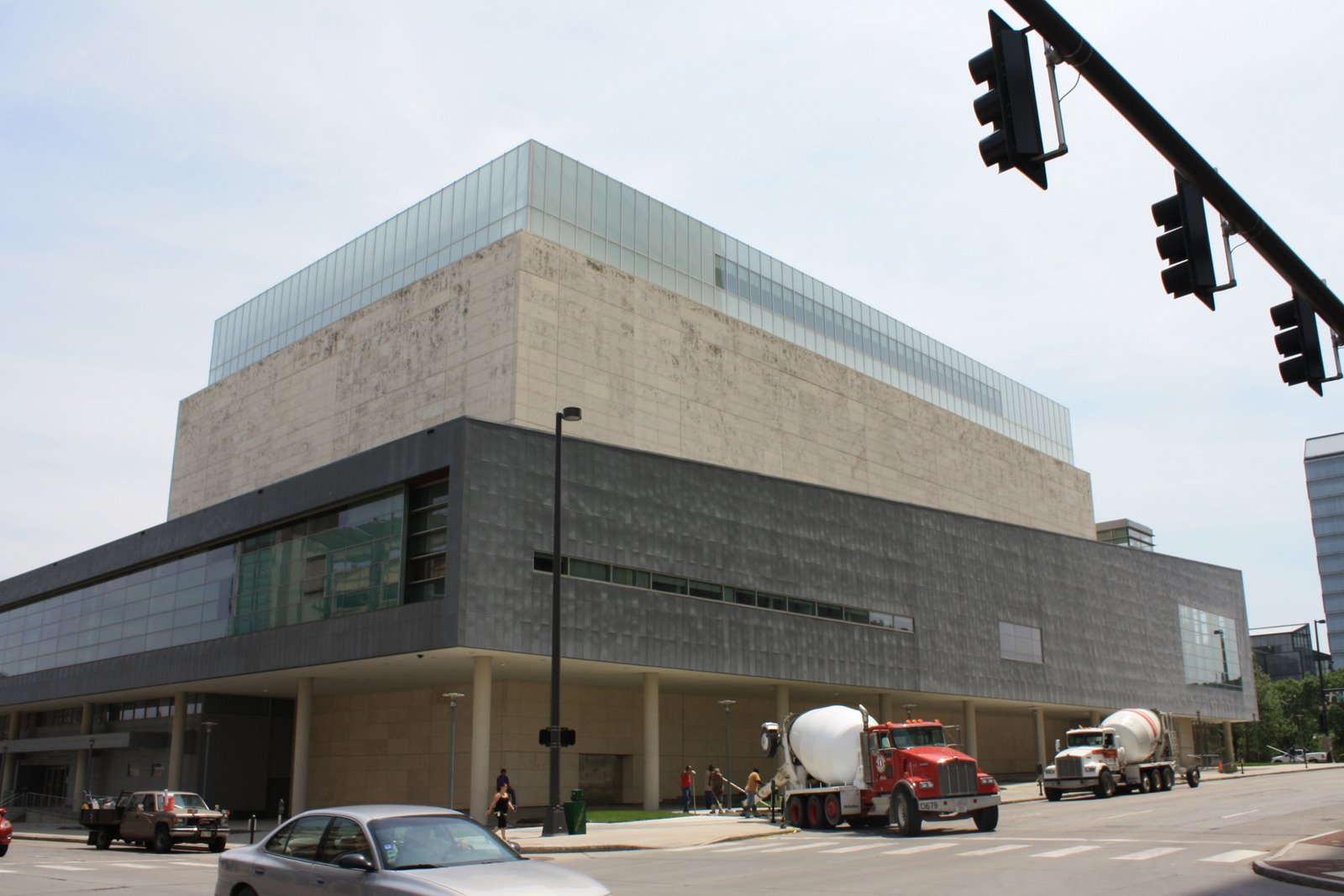
Omaha's Holland Performing Arts Center


The Holland Performing Arts Center was opened in 2005.  It is spare in design with little lobby decoration (where are the modern painting?).  Nevertheless, the auditorium is spectacular.  It is nearly perfect acoustically.  It has a noticeable reverberation with fairly long decay.  It does not muddy the sound and the various sections of the orchestra are easily identified.  This was particularly noticeable in Vaughn Williams "Variations on a Theme by Thomas Tallis", where the string quartet was sonically separate from the full string ensemble.  The Omaha Symphony sounded first class in this environment.  The music director of the orchestra is Thomas Wilkins, a tall, elegant man who actually wore a tuxedo to conduct.  He was impressive, both in the "Tallis Variations" and in the Mahler Seventh.  I was really impressed.  Oh that Atlanta could have such a wonderful concert hall.